Buying land is one of the biggest decisions you’ll make when planning a new home. But before committing to a block, you need to understand whether it will suit the home you want to build and whether the entire project fits your budget.
Before buying land to build a home in Australia, check that the block can accommodate the type of home you want and that the entire project fits your budget.
Important considerations include setbacks, easements, planning restrictions, flood and bushfire risks, slope, soil conditions, service connections, construction access and orientation.
It’s also worth having a suitable builder or qualified designer assess the land and obtaining legal advice before making a binding commitment.
Finding the right block of land can be exciting.
You might discover a property in a great location, with an attractive outlook, plenty of space and a price that seems reasonable.
You start imagining your new home sitting on the block, perhaps with a beautiful outdoor entertaining area, a double garage and enough room for everything your family needs.
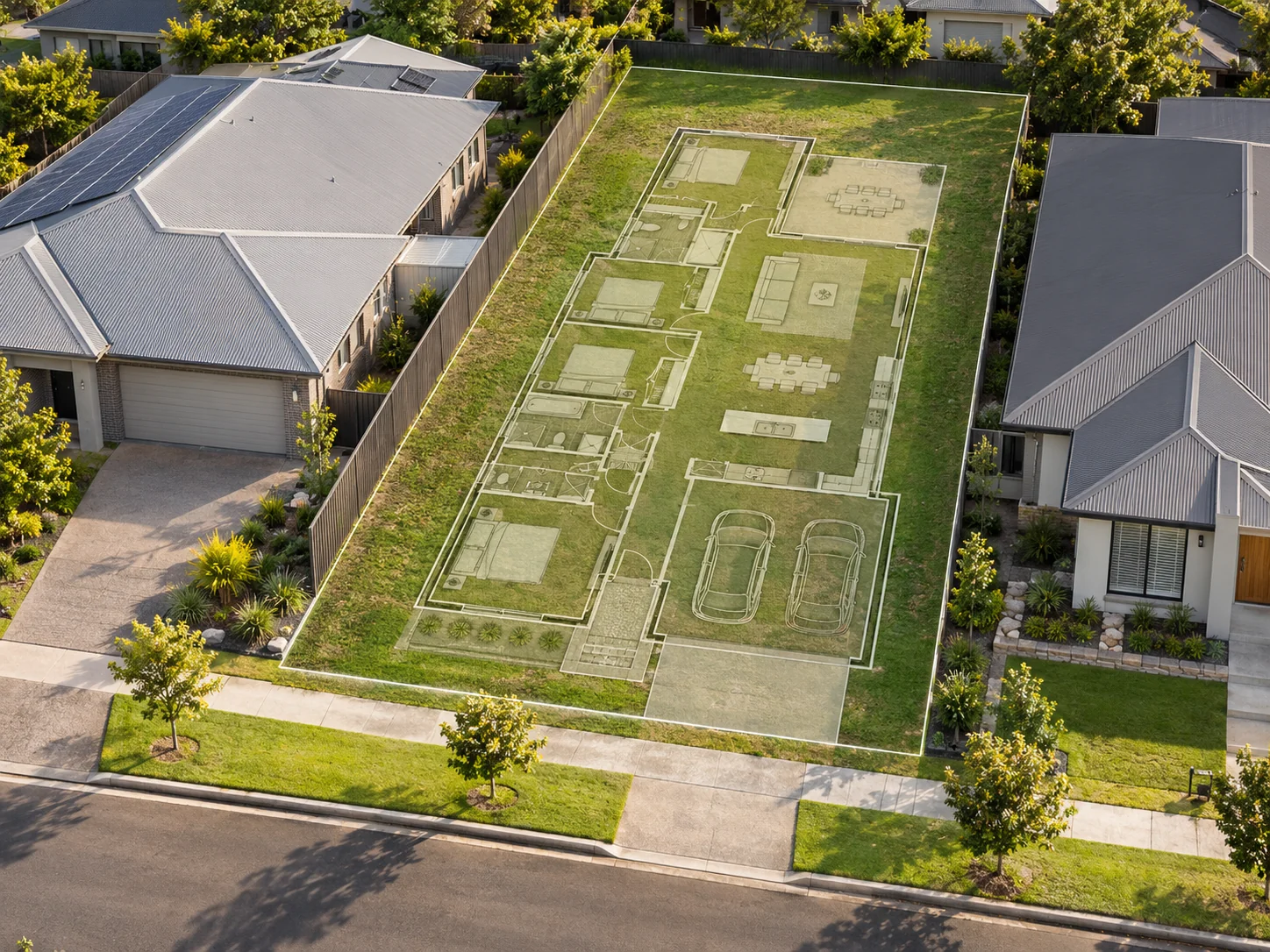
A block might look perfect until you discover it won’t accommodate the type of home you want.
Another block might be large enough for your preferred design but require expensive excavation, retaining walls or additional foundations.
And a home design that appears affordable might no longer fit your budget once you’ve allowed for the land, site costs and everything else needed to complete the project.
You don’t necessarily need completed architectural drawings before looking for land. But you should have a clear understanding of what you’re hoping to build, the space you’ll need and what you can realistically afford.
The aim is to find the right land for the right home, within a realistic overall budget.
Here are seven important things to consider before committing to a block.
1. Establish Your Home Requirements and Overall Budget First
Before seriously considering blocks of land, I’d recommend spending some time working out what you want from your new home.
This doesn’t mean choosing every finish or having your entire floor plan finalised.
It means understanding your priorities well enough to know what type of property you’re looking for.
For example, are you planning a single-storey or double-storey home?
Would you like four bedrooms, two separate living areas, a double garage and a generous alfresco area?
Do you want a swimming pool, space for a caravan or enough backyard for children to play?
Perhaps you’re downsizing and would prefer a smaller, low-maintenance home with fewer rooms and minimal outdoor work.
These decisions affect the size, shape and configuration of the land you’ll need.
Think about the floor plan
You might have already found a house design you really like.
That’s a useful starting point.
By looking at the design’s approximate dimensions and layout, you can begin to understand which blocks might accommodate it.
But don’t assume that a block will suit the home simply because its overall dimensions appear large enough.
Setbacks, easements, access, orientation and other restrictions can all influence where the home can be positioned.
You might also discover that the floor plan needs some changes to make better use of a particular block.
Our article Choosing the Right Floor Plan: 7 Things to Consider Before Building explores how to assess layouts, orientation and practical room sizes before settling on a design.
Establish your total project budget
This is equally important.
If you have an overall budget of $900,000, that doesn’t mean you should simply spend $450,000 on land and assume the remaining $450,000 will cover everything else.
You need to consider the likely cost of the home you want, the land purchase, site works, connections, external works, fees and other project expenses.
You also need to allow for unexpected costs.
Until you’ve developed a reasonable understanding of those expenses, it’s difficult to know how much you can comfortably allocate towards the land.
Sometimes spending more on a well-suited block can reduce construction costs.
Other times, a cheaper block may provide better overall value.
The decision should be based on the complete project, not simply the advertised price of the land.
2. How Much of the Block Can You Actually Build On?
A vacant block can look surprisingly spacious when there’s nothing built on it.
But the area available for construction may be considerably smaller than you expect.
That’s why it’s important to look beyond the advertised land size.
Block dimensions and shape
Two blocks might both contain 500 square metres, yet offer very different building opportunities.
One might have a generous frontage and a fairly regular rectangular shape.
The other could be narrow, irregular or affected by restrictions along one side.
If you’re planning a wide single-storey home, the first block might be ideal.
The narrower block could require a different layout or perhaps a double-storey design.
Neither block is necessarily better.
It depends on what you’re hoping to build.
Setbacks and building envelopes
Setbacks determine how close a building can be positioned to particular property boundaries.
The requirements vary depending on the location, planning controls and proposed design.
Some housing estates also have building envelopes that restrict where a house can be constructed.
These requirements can affect the home’s overall dimensions and where garages, outdoor areas and other features can be positioned.
Easements
An easement may give a service authority or another party certain rights over part of the property.
Common examples include easements for drainage, sewerage or access.
Depending on the circumstances, these can restrict where you build or require additional approvals.
You shouldn’t assume that because an area is vacant, it can automatically be used for a building, swimming pool or retaining wall.
Property boundaries
It’s also worth establishing exactly where the legal property boundaries are located.
Existing fences aren’t always positioned correctly.
Where the boundaries are unclear or important to the proposed design, a licensed surveyor may need to confirm their location.
Before committing to a block, I’d want to establish whether the type of home you’re planning can reasonably fit within the available building area.
That assessment should involve the relevant builder or an appropriately qualified designer where needed.
3. Are There Planning Restrictions, Flood Risks or Other Hazards?
Just because land is advertised as residential doesn’t necessarily mean you can build whatever you like on it.
Local planning schemes and other regulations may affect the type, size and position of the home.
Before purchasing, it’s worth checking the property’s zoning, relevant overlays and any other planning restrictions.
These might relate to building height, site coverage, setbacks, vegetation, heritage considerations or other local requirements.
Flooding and stormwater
One thing I’d pay particular attention to is how water moves through and around the property.
Is the block affected by a flood overlay?
Does it sit below neighbouring properties?
Is there a natural drainage path across the land?
Could heavy rain cause water to accumulate where you’re planning to build?
Even when a property isn’t covered by a particular flood overlay, it can still be worth investigating drainage and overland flow.
Depending on the circumstances, additional drainage works, minimum floor levels or other design measures may be needed.
These requirements can influence both the house design and construction costs.
Bushfire risk
Properties in designated bushfire-prone areas may have additional assessment and building requirements.
These can influence building materials, window specifications, site planning and other aspects of construction.
The costs will depend on the applicable requirements and proposed design.
Other restrictions
There may also be estate covenants or design guidelines that influence your choices.
For example, an estate might have requirements relating to external materials, roof forms, fencing or other design features.
These aren’t necessarily problems.
However, they need to be understood before selecting a design or committing to the land.
Don’t automatically dismiss a challenging block
A property with planning restrictions, flood considerations or other constraints isn’t necessarily unsuitable.
Some challenging blocks can be developed into excellent homes.
But those challenges need to be investigated properly.
The question isn’t simply whether you can build on the land. It’s whether you can build the home you want, at a cost that makes sense.
Your local council, relevant authorities and appropriately qualified consultants can help establish what applies to a particular property.
4. Will Slope and Soil Conditions Affect the Cost to Build?
This is an area where two blocks with similar purchase prices can end up costing very different amounts to build on.
A relatively flat block with favourable ground conditions may be straightforward to develop.
A sloping block, or one with more challenging soil conditions, might require additional engineering and site preparation.
Sloping blocks
I wouldn’t automatically rule out a sloping block.
In fact, some of the most interesting homes are built on sloping sites.
They can provide opportunities for elevated views, split-level designs and creative use of the land.
But those benefits may come with additional costs.
Depending on the site and design, construction could involve excavation, retaining walls, additional drainage, changes in floor levels or more complex foundations.
A standard project-home design may also need significant modifications.
Sometimes those additional costs are justified by the benefits of the location.
Other times, they can make an otherwise appealing block financially unsuitable.
You need to understand the likely construction implications before deciding whether the land represents good value.
Soil conditions
What lies beneath the ground is another important consideration.
Different soil conditions can influence how the home’s foundations are designed and constructed.
Reactive clay, rock, fill, poor bearing conditions and groundwater can all introduce different requirements.
A geotechnical investigation or soil test can provide important information for the builder and engineer.
Where appropriate, I’d recommend investigating these matters before becoming unconditionally committed to purchasing the land.
Site preparation and drainage
Also consider whether the block needs additional earthworks, retaining walls, vegetation removal or drainage improvements.
Some blocks might need relatively little preparation.
Others could involve substantial costs before construction of the actual home begins.
A suitably qualified builder or consultant may be able to provide early advice about the likely requirements.
However, an accurate final cost may not be available until surveys, testing and engineering have been completed.
That uncertainty needs to be considered when establishing your budget. For a wider breakdown of possible expenses, see The Hidden Costs of Building a New Home in Australia.
5. Confirm Services, Connections and Site Access
When looking at land in an established residential area, it’s easy to assume that all the necessary services will be available.
But availability and connection costs can vary considerably.
Before purchasing, establish what services are available to the property.
These may include water, sewerage, electricity, telecommunications and, where relevant, gas.
Available doesn’t always mean connected
For example, a sewerage main might run along the street, but that doesn’t necessarily mean the property already has a suitable connection.
Additional work may be required.
Similarly, electricity infrastructure might be nearby, but the cost of providing the required connection can depend on the circumstances.
In some locations, onsite wastewater arrangements may be necessary instead of connection to a conventional sewerage system.
These matters can affect the cost of the project and, in some cases, the available building area.
Consider construction access
It’s also worth thinking about how the home will actually be constructed.
Can excavation equipment access the site?
Is there sufficient room for concrete trucks, building materials and other deliveries?
Could a narrow road, steep driveway or restricted working area create additional challenges?
Builders may need to use different construction methods or equipment to accommodate difficult sites.
Again, that doesn’t necessarily make the property unsuitable.
But it can influence the building cost.
A block should be assessed not only for the finished home, but also for what will be involved in constructing it.
6. Consider Orientation, Neighbours and How You’ll Live in the Home
A block might have all the practical characteristics needed for construction and still be less than ideal for your preferred design.
That’s why it’s important to think about how the home would function once it’s built.
Orientation and natural light
The direction a block faces can influence where you position living areas, bedrooms, windows and outdoor entertaining spaces.
In many Australian climates, north-facing living areas with suitable shading can help create comfortable spaces with useful winter sunlight.
In hotter tropical regions, managing unwanted heat and taking advantage of cooling breezes may be particularly important.
There’s no single perfect orientation for every home.
The best arrangement depends on the local climate, the block and how the home is designed.
Consider the relationship between the home and land
Imagine you’ve found a floor plan with a beautiful open-plan kitchen, dining and living area leading onto a large alfresco.
That’s great.
But when you position it on a particular block, you might discover the alfresco faces an undesirable direction, overlooks a neighbouring property or leaves very little usable backyard.
An alternative layout might make much better use of that same block.
You might find a block you really like and then adjust your preferred design to make better use of it.
Or you might discover that the changes required would compromise too many of your priorities.
In that case, looking for a different block could be the better decision.
Privacy and neighbouring properties
Look carefully at the surrounding properties.
Where are neighbouring homes positioned?
Could future buildings affect your privacy or natural light?
If nearby blocks are vacant, what could reasonably be constructed on them?
Also consider whether there are nearby roads, commercial activities or planned developments that could influence traffic, noise or the general character of the area.
Visiting the property at different times can help you understand what living there might be like.
You’re not simply buying a block that can accommodate a house. You’re choosing the setting for your future home.
7. Bring Everything Together Before Making a Commitment
By this stage, you should be developing a clearer understanding of whether a particular block is suitable.
But there’s one final step I’d strongly recommend.
Bring the land, preferred home design and total project budget together and assess them as one project.
Consider the complete picture
Let’s say you’re working with an overall budget of $1 million.
You find a block you really like for $450,000.
You’ve also identified a home design with an advertised starting price of $400,000.
At first glance, it might look like you’ve allowed plenty of room for the other expenses.
But after investigating the block, you discover the home needs substantial modifications.
There are additional foundation costs, drainage works and other expenses you hadn’t originally considered.
You also need to account for upgrades, connections, external works, purchase costs and the other items required to complete the project.
Suddenly, the overall budget might be getting stretched.
Now imagine another block costs $480,000.
It might appear less attractive because of the higher purchase price.
But if it’s better suited to your preferred design and requires substantially less site preparation, it could potentially result in a lower overall project cost.
That’s why looking at land prices in isolation can be misleading.
Be prepared to adjust your plans
Sometimes the best solution is to change the floor plan.
Sometimes it’s to reconsider the land.
And sometimes you might need to adjust your expectations about the overall budget.
You don’t necessarily need to have every answer before you begin looking.
But you do need to work through the important questions together before making commitments.
Get appropriate advice before signing
Before signing a land contract, have a suitably qualified solicitor or conveyancer review the documentation and explain your obligations.
Depending on the circumstances, it may also be worth discussing whether suitable contract conditions can provide time to investigate finance, soil conditions, planning restrictions or the suitability of the land.
The availability and effectiveness of these conditions vary according to the contract, transaction and state or territory.
Don’t assume you’ll automatically have the right to withdraw if you discover a problem after signing.
Where necessary, obtain advice from surveyors, engineers, town planners, builders or other qualified professionals.
A final pre-purchase check
Before signing or becoming unconditionally committed, aim to understand:
- Design feasibility: Can the type of home you want reasonably fit on the block, taking account of the available building area and applicable restrictions?
- Site and servicing costs: Have the significant uncertainties around soil, slope, drainage, connections and construction access been investigated, with suitable cost allowances where exact figures aren’t yet available?
- Total project budget: Is the combined cost of land, building, site works, other expenses and a sensible contingency realistic for your circumstances?
- Contract conditions and obligations: Has your solicitor or conveyancer explained what protection, if any, the contract gives you while further investigations or finance arrangements are outstanding?
Not every question can necessarily be resolved before signing. What matters is knowing which matters remain uncertain, getting appropriate professional advice and understanding the risks and contractual deadlines before you proceed.
The more you understand before committing, the better positioned you’ll be to make a decision that works for your entire project.
Should You Choose a Builder Before Buying Land?
This is another important question because the builder, land and home design all influence what’s achievable.
I don’t believe you necessarily need to have selected or signed a contract with a builder before purchasing land.
However, I do believe it’s useful to understand the types of builders and home designs that may suit your requirements.
Different builders offer different levels of design flexibility.
Some work primarily with standardised home designs and defined modification options.
Others specialise in custom homes or more challenging sites.
Those differences can matter when you’re assessing land.
For example, if you’re considering a narrow or steeply sloping block, you’ll want to understand whether the type of builder and design you’re considering can accommodate those conditions.
Getting early advice from suitable builders can help identify potential issues.
However, I’d be cautious about committing to a particular builder before you’ve properly explored your options.
The priority should be developing a coordinated plan for the home, land and overall budget.
Once you have a clearer understanding of what you need, you’ll be in a better position to identify which builders may be suitable.
How New Build Assist Can Help
One of the main reasons I started New Build Assist was to help people work through these important decisions before making major commitments.
It’s common to begin by visiting display homes, looking at floor plans or searching for vacant land. The challenge is understanding whether your preferred options are practical once site requirements and the full cost of construction are considered.
As an independent new-home advocate, I help clients work through what they want to build, where they want to build and what they can realistically afford.
That includes understanding their lifestyle, preferred home design, land requirements, priorities and overall budget.
We can explore different home layouts, consider how they might work on suitable blocks and identify where adjustments could improve the outcome.
If you’ve already found a block you’re interested in, I can help you consider how it aligns with your intended home and identify questions or potential issues that should be investigated before proceeding.
Where specialist advice or formal assessments are needed, such as surveying, soil testing, engineering, planning or legal advice, those matters should be handled by appropriately qualified professionals.
I can also help you explore suitable builders and understand how their designs, building approaches and indicative costs align with your requirements.
My aim is to help you identify practical opportunities and potential problems early, so you can make informed decisions before committing to land, a design or a builder.
A Better Place to Start
If you’re planning to build a new home, a good place to start is by getting clear on what you want to achieve before making major commitments.
You might already own land.
You might have found a house design you really like.
Or you might still be exploring your options.
Wherever you’re at, we can begin with a 30-minute conversation about the type of home you want to build, where you’d like to build and the budget you’re working with.
I’ll then prepare a short Personalised Build Plan outlining your priorities, what still needs to be considered and some sensible next steps.
There’s no cost for the conversation or the Personalised Build Plan, and no obligation to continue.
No cost. No obligation. Just a better place to start.